|
||||||||||||||||||||||||||||||||||||||||||||||||||||||||||||||||||||||||||||||||||||||||||||||||||||||||||||||||||||||||||||||||||||||||
|
About the SongIn November of 2013, I was asked to write an original song for the 25th anniversary of Ultima Thule, a syndicated Ambient radio show which has kindly included Longing for Orpheus in past broadcasts. My songwriting process is typically very drawn out - I work on many songs at once, switching between them over a period of many months, or a few years. I had no idea whether I'd be able to find a worthwhile new musical ideaand develop it into a polished song in the six weeks I had available for this project, but I'm extremely happy with how it turned out. The Ultima Thule broadcast featuring Silhouette is available from iTunes as a free podcast - just search the iTunes store for "Ultima Thule UT1010", or follow this link. AvailabilitySilhouette is available exclusively at Bandcamp - through May, it's a free download! Echoes of Somnia
About the album...Echoes of Somnia is a collection of instrumental mixes of the tracks from Somnia. I hesitate to say ‘remixes’, because that word has come to mean something more drastic...more of a reinterpretation...than what these are. They’re the same songs, conveying (or intending to) the same moods and musical ideas, just in instrumental form. There are also three new songs on this release, written during the same sessions as the songs on Somnia, but which didn’t fit on a vocally-oriented album. Rearranging to InstrumentalsWhen I started this project, I thought it would take two or three months to complete...I was off by about a year. In my songwriting process, I complete the entire instrumental arrangements first, and add lyrics and melody last. So, I thought putting together instrumental mixes of finished songs should be as simple as muting the vocals, and maybe tweaking a few volume levels to bring things back into balance. Even for the songs with the fewest changes, that turned out to be a pretty major oversimplification. The instrumental arrangement of Ghost, for example, includes no new instruments or parts, but the phrasing of the instrumental counter-melodies that were already written had to resculpted, note by note, so that they stood on their own as lead melodies. Most songs did end up with new parts and instrumentation. A Room Full of Stars has a new lead melody synth. The lead instrument in Sand changed from piano to harp. The supporting piano that only entered halfway through Broken Down became its lead instrument, and now enters in the first verse. There are many other changes, but there’s little point in listing them...talking about music is like dancing about architecture. In the end, I think these “Echo mixes” stand on their own, and I would have been happy to have released them as instrumentals in the first place, had Somnia never existed. New SongsI began the process of producing Somnia with many more songs (works-in-progress, at that point) than make it onto the final master. Those that were cut, were cut for various reasons, but there were three that fell by the wayside simply because they felt like instrumentals, and didn’t belong on such a vocally-oriented album. Once I found myself reworking the tracks from Somnia as instrumentals, it occurred to me that it was the perfect opportunity to finish what would eventually be called Unearthed, Spellbound, and Tracing Inspiration as well. Unearthed - Statistically, the most likely reason for you to know that Longing for Orpheus exists is that you heard a song called AetherSpark on Pandora radio. It’s by far my most popular song, but I almost didn’t release it in the first place, because I was afraid it sounded trite. I find that most truly beautiful music contrasts light and darkness...it can have a lot more of one than the other, but they both have to be present. I’m afraid I’ve so deeply internalized that idea that I’ve made it into a belief - a rule I’m afraid to bend or break. With early drafts of Unearthed, I had the same feeling I’d had with AetherSpark...that it was all light and no darkness, and therefore superficial. I like to think I learned something from AetherSpark, so I kept coming back to Unearthed, trying different things, taking breaks to regain perspective, and trying again. Eventually, I think I got it right...the final version of Unearthed is the single piece of music of which I’m most proud. This early version of Unearthed includes the original chorus at 1:00, which you'll hear has a similar lightness to the verses. More striking is the bridge around 2:08 - it was a heavy-handed attempt to introduce some darkness, and it doesn't really feel like like it belongs in the song at all. Spellbound - My songwriting is very iterative...months typically pass as I revisit an arrangement, until I finally consider it done. Spellbound, however, went from the seed of an idea to a complete arrangement in about two weeks. Here's what that sounded like: There was one final hurdle, though, and I nearly gave up on the song altogether when I couldn't find a lead synth that sounded right for the chorus. I intended for Spellbound to have a very Trance-influenced palette and style, which would mean an all-synth arrangement, so it was only as a last ditch effort to save the song that I started playing along with acoustic instruments. When I heard how the flute fit into the mix, I knew immediately that it was what had been missing. It took significantly longer to record and arrange the layered flute melodies you hear in the final mix than it did to write the rest of the song, but it was absolutely worth it. Tracing Inspiration - I've heard other songwriters talk about listening for what a song "wants", and thought it strange, but I learned what they meant while working on this one. The inverse of Spellbound, Tracing Inspiration took forever to arrange. The initial seed idea came easily enough, but I spent many months trying to shoehorn that idea into a verse-chorus structure. Eventually, I took a step back and realized that the seed idea wanted to be the song's climax. All the repetition was ruining its impact, so I abandoned the too comfortable verse-chorus model in favor of the arrangement you hear on the album. Here's an early arrangement with the seed idea as oft-repeated chorus: Further accentuating Tracing Inspiration's "oppositeness" to Spellbound, you'll hear a flute part in the early version. I began this song with the intent of writing it around the flute, but eventually realized it was in the way. AvailabilityEchoes of Somnia is available for streaming and download from iTunes, Spotify, Bandcamp and CD Baby, and most other music sites. CDs will soon be available from Amazon and CD Baby. Artwork(click these images, or the cover art above, to see full size) 

Somnia
AvailabilitySomnia is available for streaming and download from most major music sites, including iTunes, Bandcamp and Spotify. CD Baby and Amazon carry the album in both digital and CD formats. About the album...These are songs of dreams, of the night sky, of hopes and fears, of love lost and love found. These are songs about the beauty in a sometimes not-so-beautiful world. With this third full-length release, Longing for Orpheus moves from a primarily instrumental project into the Ethereal realm. Singers from the opera and musical theater communities within Austin, Texas' celebrated music scene lend their voices to these songs. Songs
Artwork(click these images, or the cover art above, to see full size) 

Thank YousThanks once again to everyone mentioned on previous albums. Thanks also to the wonderful and talented musicians who collaborated with me on this release. Finally, Thanks to all the Irish Traditional Music players I've met, played with, and learned from in the past few years. You've given me new perspectives from which to approach, enjoy, and understand music of all kinds, and thereby shaped this album, whether you know it exists or not ;) Broken Down
About the SongMeredith Ruduski, the singer and co-writer of "Broken Down," is a coloratura soprano...that is to say, a classically trained vocalist. I had the good fortune to be cast alongside her in a light opera a couple of years ago, around the same time I decided to try taking Longing for Orpheus in an Ambient Pop direction. I found myself pleasantly distracted in rehearsal after rehearsal by the pure, ethereal quality of her voice, so I asked her if she had any interest in non-classical music, and if she would be interested in collaborating on a song. Fortunately, she was. All alone with the rain falling from my eyesThe stars shine clear and cold against the wet velvet sky And as they fall to earth I try to understand why A kiss from your lips should make me cry Broken down, I'm broken down again Featherlight in my dreams Permeated with memories Of your perfume, your sweet scent Why did you leave me here Broken down again As I step outside myself, and watch the waters rise I start to wonder what is real and what is my disguise If I had the chance, would I still want to know why I am bound to the earth as I watch you fly I need you to breathe I need you to see I am lost within the space Between reality and dreams Meredith's career has lent her a deep familiarity and understanding of songs and arias with bittersweet themes - those of love lost and love unrequited - and I think these lyrics flowed naturally from there. What great portion of the all the world's art, and much of the most beautiful, did Alfred Lord Tennyson summarize with a few short words: Tis better to have loved and lost,Than never to have loved at all. Cover image courtesy www.misprintedtype.com, and stock.xchng contributors ilco, sue_taylor, and Protect. AvailabilityBroken Down is now available for download from CD Baby, iTunes, and Bandcamp. The Maid of Culmore
About the SongThis a traditional Irish song that I first heard on a Paddy Keenan album, sung by Tommy O’Sullivan. I fell in love with the song, and when I started to consider doing an electronic arrangement, I listened to as many different performances as I could find. The most popular seems to be by folk singer Cara Dillon, and I understand why - her performance is beautiful. I listened to at least a dozen versions, and while a couple seem to fit somewhere within the wider New Age genre, I didn't find any that fell on the Ambient/Electronic end of the spectrum, so I created this arrangement. I hope I have done the song justice. I'm also releasing an instrumental mix as a free download. Given the stylistic gulf between my arrangement and the tradition from which the song comes, this track has only the most tenuous connection to the name "The Maid of Culmore." Yet, as it is a subtle remix of my arrangement of the song, it's the only title that seems to appropriate. Cover photo courtesy of adnanx. AvailabilityThe Maid of Culmore is available for download from CD Baby and iTunes. It is currently streaming freely at sites including Grooveshark and Last.fm. You can download The Maid of Culmore (Instrumental Mix) here (you may have to right-click -> Save As) and at Last.fm, or listen to the stream on Grooveshark. OtherSong
Production NotesTradition dictates that an album be released with notes. As more and more people get music online, and never see a physical album, printing the release notes on a CD liner seems an outmoded way of doing things. With the existence of such projects as the Internet Archive (a self-explanatory name, I think, whether it still exists as you read this or not), I suspect these 1s and 0s will be preserved long after the paper liners have crumbled. So, everything I have to say about OtherSong, I will say here. Perhaps the most common category of question that musicians encounter relates to the meaning behind names - pseudonyms, album names, song titles, etc. In this case, the album and song names are tied together, and relate to the original "philosophy" of Ambient music as initially described by Brian Eno. In his liner notes to Music for Airports, he said: "Ambient Music must be able to accommodate many levels of listening attention without enforcing one in particular; it must be as ignorable as it is interesting." My hope is that these songs will hint at different ideas, places, and things to each listener. I did not want to impose any solid ideas by providing concrete names, so I sought for words that I found particularly evocative, and combined them in ways that set my own imagination to work. You may notice that [almost] all of the names,including the album title, have the same three-syllable structure. I have read that it is something of an axiom among those interested in the creative process that imposing structure on art (the verse-chorus song form, the rule of threes in photography, or the sonnet form in poetry are a few of myriad examples) stimulates creativity, rather than stifling it as one might intuitively expect. If you ever find yourself suffering from writer's block, for example, try forcing yourself to write in haiku form, or adopt ample alliteration. The result may or may not be quite what you need, but it will likely help to get you past your block. To get back to the subject, Mr. Eno's statement of purpose for Ambient music guided my decision to include no English lyrics on this album. While I would be quite pleased to know that someone is giving their full attention to my music, I would derive equal pleasure to know that it is being used as (for lack of a better word) background music - what matters is that someone is listening. I find that there are few things as distracting as someone's thoughts being suddenly verbalized out of nowhere. I considered removing all vocals from the album altogether, but decided that those that remain lent more than they distracted. When I released Skye in 2006, I thought to myself that the time between releases from some of my favorite artists was absurdly long (Enigma in particular, who has been on a rough 3-year schedule since the beginning). Yet, here is OtherSong, three and half years after Skye. As with Skye, most of the production work took only a few months of spare time. I have realized, in retrospect, that the flow of new ideas is a serious limiting factor - while the bulk of the engineering on these tracks occurred only recently, the initial ideas from which the songs grew are dated from earlier this year, back to when I was working on Skye in 2006. Also, all ideas are not equal. For every complete track on OtherSong, there are two or three incomplete tracks on my studio's hard drive, some of which ended up leading nowhere or sounding like inferior equivalents of songs that are on the album. Others are simply the wrong style for Longing for Orpheus, or for this album in particular, and may end up being released somewhere else. While I continue to hope that I will develop the focus to produce music more consistently, I know that other projects and responsibilities will continue to vie for my attention. Computer LoveI suspect that sponsorships are the primary reason many albums include a list of brand names of instruments and recording equipment. I have no such obligations, but musical instruments are, themselves, works of art, and I would like to acknowledge some of them. My main sequencer is Sonar, though much of the rhythm section is provided by the generally-underrated Fruity Loops. A disproportionate amount of the synthesis on this album is provided by Native Instruments softsynths. Most of the melodies and harmonies were originally written on, and recorded through a Yamaha S80, which has a full-sized keyboard with wonderfully piano-like action. EthnomusicologyYes, that's a real word - part of the curriculum for music students at my college was a World Musics course, and this is the proper term for what we studied. This type of course (surveying the music of various cultures) can be interesting and enlightening, but it will shatter any illusions you may have that my style of music (and by extension, Enigma, Waterbone, Delerium, to a lesser degree Deep Forest) are really representative of the music of other cultures. Our music simply incorporates the sonic palate of other music traditions into the harmonic and melodic framework of Western Music; we still use the musical scales, song structures, and various other trappings of the Western classical and jazz traditions. Every culture's musical traditions can be wonderful and enchanting in their own right, and I highly encourage you to seek them out, but be forewarned that it takes some work to appreciate them. Musical preferences are, in large part, learned preferences - they develop over the course of our lives, based on what we listen to. So, even if you seek out the best and most famous recordings of, for example, Indian sitar music, don't expect to fall in love with it at first listen. Commit to playing it in the background on different occasions, over a period of time, interspersed with your usual fare. Do research into the elements of music as that culture sees it, and you'll have a much more enjoyable experience in the long run. Now, with all the disclaimers and caveats out of the way, lets talk about the actual World Music aspects of OtherSong. CopperSea - The flute-like instrument that first comes in around 0:55 is a sampled Shakuhachi - a Japanese bamboo flute, nearly two feet long, that is notoriously difficult to master. If you're listening to my music, you've almost certainly heard the Shakuhachi before - it features prominently in Enigma's Sadeness - Part 1, as well as many, many other recordings. I frequently hear it used in film and television soundtracks to lend a "exotic" air to things. Sadly, it seems that everyone uses the same small sample, and so we hear a breathy, descending major fourth over and over and over. The instrument has much expressive potential beyond this interval trick, so I avoided that particular sound in CopperSea. NeverTale - This song is a multicultural playground. The main rhythm and harmony instrument is, of course, a harp, which is associated with both Classical and Celtic music. The breathy flute that comes and goes throughout the album is a handmade Navajo flute. The sound you hear in this song isn't very representative of how the flute sounds in person - I added a lot of reverb to lend a sense of space and depth. Finally, mutliple tracks of Djeme come in at the bridge (around 3:05), and keep going through the final chorus. The djeme is goblet-shaped hand drum, which is thought to have originated in West Africa, but has been adopted in various forms by myriad cultures. I believe mine, which is a hand-carved specimen with about a 10" head, was made in Java or Bali, but I'm relying on my memory of what a salesmen told me a number of years ago. EverSoul - One of my favorite instruments is the Erhu, sometimes called the "Chinese Violin", and it (at least a sample-based synthesis of it) is the focus of this song. Both the main melody and string section in the choruses are Erhus. It bears sonic similarity to a violin because it is a bowed string instrument, but it is unique in that the bow actually fits between the instruments two strings, and so cannot be separated without restringing. Like the western violin the erhu is a wonderfully expressive instrument, and while the MiniErhu softsynth has captured some some fine examples of expressive elements, it's very difficult to emulate via synthesis the crying glissandos of a skilled human player. WinterStage - Another traditional Chinese instrument features in the second half of this song (entering at the bridge around 1:55). This one is a plucked string instrument called the Pipa. I used a combination of a sample-based synthesizer to create most of the melodic lines, and some longer samples of musical phrases played on an actual Pipa. The rhythms in the song include a hefty number of Bodhran samples - the Bodhran is a frame-drum used to accompany Celtic tunes, and you're likely to see one or more at any tune session. It's an unusual percussion instrument, in that it is played with a double-ended stick called a "tipper." CloverLight - This song features two Tin Whistles, also known as Penny Whistles or Irish Whistles. The main whistle is a Low D model, and is actually a PVC instrument despite its name (this is the same flute I played on Athar from the previous album). It is my understanding that low whistles came into prominence only recently, thanks to Davy Spillane's performances on Riverdance. The higher, more piercing tone comes from a more traditional D whistle by Clarke - it is simply doubling the melody an octave up for most of the song. But, it is featured prominently on the next song... UmbraStory - As I mentioned earlier, I considered not including this song on the album, out of fear that it's being the sole vocal song would throw the balance. But, I love the juxtaposition of the Irish whistle, so closely associated with Celtic music, and the Chinese vocals. These vocals came from a sample CD (there are entire businesses that exist purely by creating sample CDs and selling them to musicians - its a small world, you can hear one of the samples I used in the background music of an episode of Firefly), and I'm sadly unaware of what they may mean. If anyone speaks the dialect, I'd love a translation. In any case, I treated the vocals as another sonic texture, and they're placed as they are in the song purely for melodic and harmonic reasons. ArtworkThese are links to the full-sized album art; if you have a slow internet connection, consider how long you're willing to sit and watch them load, as they're very large. Many thanks to Claudia Meyer, on whose beautiful photographs all the artwork is based. 


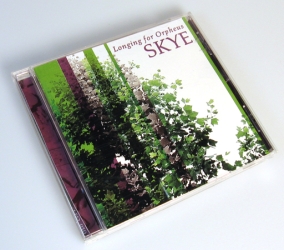
Thank YousOf course, no work of art is truly the sole creation of the artist, but is the result of everyone and everything that has contributed to the artists' abilities, tastes, and personality. To that end, Thanks to all of my music teachers, in particular Dr. Robert Whalin, Peggy Brunner, Linda Dogherty, Dr. Joey Martin, and Bill Parcher - though I seriously doubt any of you expected your teachings to be incorporated into mellow electronica, you all shaped my sense of musicality, and I hope the best of that came out on this album. Thanks also to Richard Evans and Sam Trim - I am indebted to you both for showing me the ropes. Thanks to all friends and theater families keeping me busy and connected. Thanks to my parents and family for helping me get to a place where I can undertake this kind of project. And of course, much love to Becca and Pan for every day. AvailabilityOtherSong is now available from CD Baby, iTunes, and Amazon, and many other online stores. SkyeSkye is Longing for Orpheus' debut album, released in February of 2006.
ReviewsBill Binkelman review at the New Age Reporter. RJ Lannan's review at the New Age Reporter. Brian Douthit's review at CD Baby (previously at Perfectly Said). Informal review from the Enigma Message Board by Jay Rivera of Black Ether: There's a lot of music these days that people refer to as New Age, mostly because they can't get their arms around it to firmly categorize what they are hearing. The result is that a lot of so-called "new age" is not new age at all, but progressive electronica in disguise. But there is a sound that most old time purists like myself, those of us that came through the school of Tangerine Dream, that represents what New Age is really all about. A post electrionica, neo classical sound that feeds on texture and emotion. Over the past week Ive had the pleasure of immersing myself in a CD that captures this sound with such stunning precision that it's gotten exclusive play on my car CD player (i do most listening in my car). Lush, bold, epic, perfectly orchestrated and full of feeling. Inspiring as hell and easily the best New Age CD I've heard in a very long time. A MUST listen for anybody who professes to love the genre and those who aren't quite certain what new age is. This is it, in all its glory, as good as it gets and on a par with the old masters who created the genre. Stories
AvailabilityPhysical copies of Skye are available at CDBaby. MP3 versions are available from a variety of online music stores, including iTunes, Amazon, Rhapsody and Soundclick. |
|||||||||||||||||||||||||||||||||||||||||||||||||||||||||||||||||||||||||||||||||||||||||||||||||||||||||||||||||||||||||||||||||||||||
|
Longing for Orpheus | After Enigma |
||||||||||||||||||||||||||||||||||||||||||||||||||||||||||||||||||||||||||||||||||||||||||||||||||||||||||||||||||||||||||||||||||||||||
| Copyright 2006-2009 Derek Smootz | ||||||||||||||||||||||||||||||||||||||||||||||||||||||||||||||||||||||||||||||||||||||||||||||||||||||||||||||||||||||||||||||||||||||||
| Photographs by George Bosela and Sara Nevalainen | ||||||||||||||||||||||||||||||||||||||||||||||||||||||||||||||||||||||||||||||||||||||||||||||||||||||||||||||||||||||||||||||||||||||||